You Are Not a Machine
On removable friction, irreducible constraints, and the wisdom to know the difference.

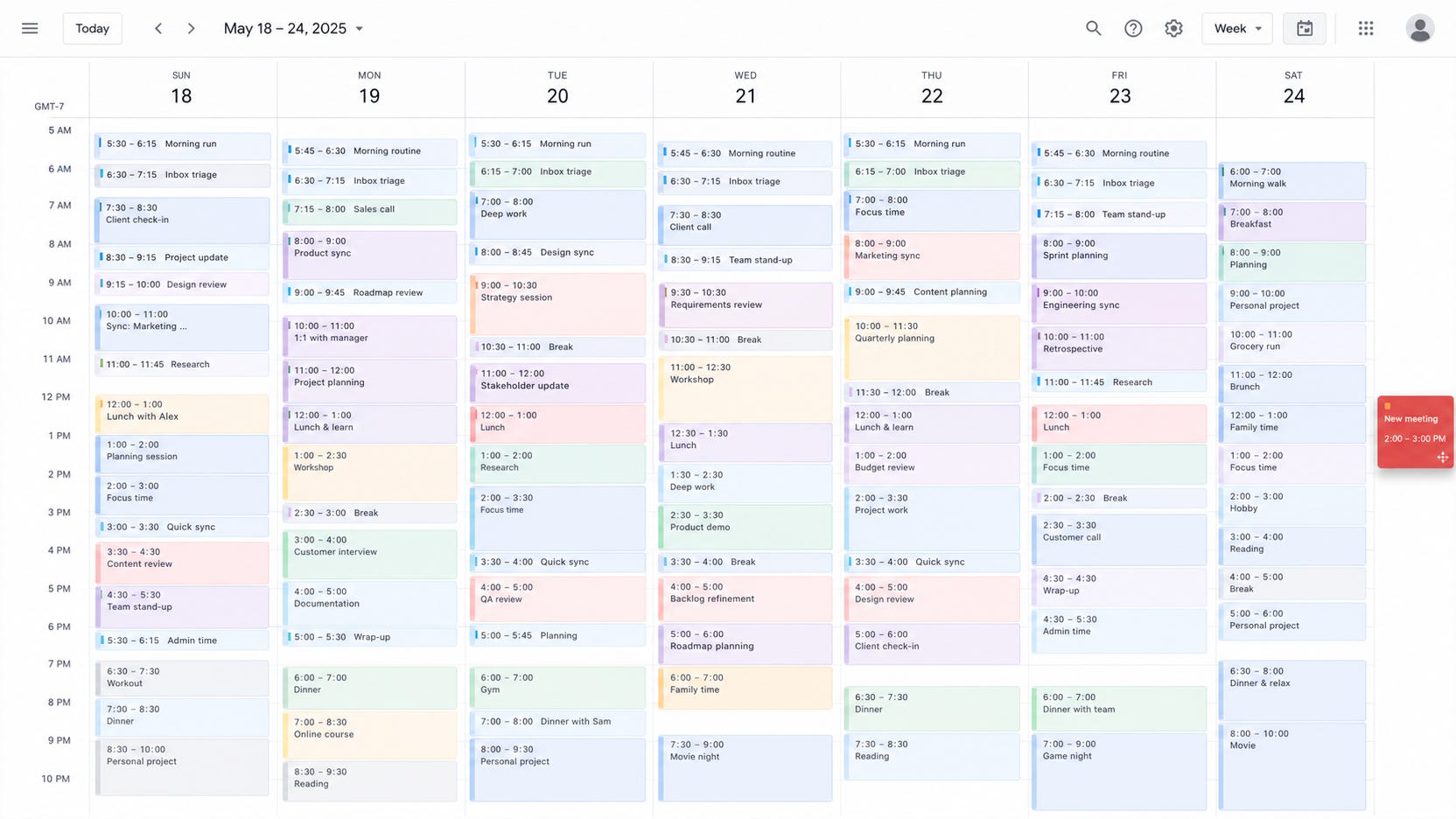
Every day I use AI a little bit more intensely in my personal and professional life. The personal use cases are more interesting, and I’ve written about some of them here already: writing children’s stories, planning workouts, filling out obnoxious paperwork like taxes and health stuff. In general, though, I noticed a trend: most of the work I’m doing with AI tools today is about efficiency and optimization.
That makes sense for two reasons. One, AI is really good at this stuff. Give the AI a clear objective and enough context and it’s remarkably good at coming up with ideas that I wouldn’t have otherwise considered; ideation is the first step towards optimization.
And two, I’m really into this stuff. As an engineer I was trained to do this. Optimization comes naturally to me. Take a complex problem, break it down into constituent pieces, solve it piece by piece. There’s an ever-present background process in my brain that’s always looking for things to optimize: in my personal life, my work, and the world around me.
Locked In 👨💻
Ten years ago my image of the ideal life was the fully optimized life, the maximal life. That means squeezing in everything possible, balancing everything, optimizing everything. Maximal travel. Maximal time spent with friends. Maximal time on focused work and on family. Maximal time on health and fitness. Of course there are trade-offs among these things and they are to some extent zero sum, but like any system there’s an optimal configuration.
I decided that the best way to achieve this was to record, analyze, and then optimize everything. I started by putting everything into spreadsheets. I tracked my diet, my sleep, my budget, and who I spent time with. I tracked my time down to 15-minute intervals.
A great embodiment of this maximization mindset is Soylent. For the uninitiated, Soylent is a “meal replacement”: essentially a mildly sweet drink with the consistency of pancake batter that’s optimized to contain precisely what your body needs, and nothing it doesn’t. Unsurprisingly its creator is also a software developer.
I discovered Soylent sometime around 2014, not long after it debuted, and for a while it was my main source of calories. I didn’t just drink Soylent, I lived the Soylent life. I always carried it with me, I advocated for it, I handed out samples to friends and colleagues, and I told everyone how much more efficient it made my life. To be clear, the efficiency of Soylent is real: if you believe that it’s the only thing you need to eat, it saves an enormous amount of time and money that you’d otherwise spend shopping for, preparing, and cleaning up after meals. Even replacing one or two meals a day with Soylent makes a difference in terms of convenience and efficiency. It really suits the engineer/startup lifestyle.
My instinct about everything, diet or otherwise, was always the same: Analyze processes. Collect data. Identify the bottlenecks, and remove them one by one. (See: Amdahl’s law.) Soylent is sort of the logical conclusion of running this process on your diet. (It still exists, and I still drink it from time to time, but it turned out that the universe of people who really want to replace food with batter is pretty small so it remains quite niche. Also, notwithstanding the science behind Soylent, there are still benefits to eating whole foods.
That instinct has continued to the present. The tools are much more powerful today but the idea is the same. Today, AI is helping enormously with optimization of certain systems including coding and health. My coding work is far more efficient and productive than it used to be thanks to AI. As for health, that’s obviously also a system—a pretty complex one. This system, too, is in better shape than it used to be.
I wrote before about some examples of how I’m using AI to improve my health, so I won’t belabor the point here, but it’s exactly the sort of thing that AI is good at. Modern AI tools have helped me sort through data I’ve collected for decades, run exploratory analyses, and generate hypotheses worth testing. They’ve surfaced ideas that have helped me materially improve my sleep and diet. They’ve allowed me to squeeze more out of my exercise time by reordering workouts, managing training loads, and planning runs and strength training sessions. They’ve even introduced me to new therapies and interventions. Because I can try changes myself and observe what happens, the feedback loop is useful, even when it can’t establish why something worked.
These days, rather than manually entering everything into spreadsheets, in most cases, I tell my agent and he updates the spreadsheets for me. In some cases we skip spreadsheets entirely in favor of other data structures and databases.
My approach to AI here, as elsewhere, and as I’ve written about many times, is to invite AI into every corner of your life. That’s served me well so far. The impact is bigger in some areas than in others, but I’ve found some use for it just about everywhere. Aside from health and work, it’s also helped me optimize time management, my travel schedule, and the childcare schedule.
Thanks to AI, I feel like we’re heading for a beautiful, optimized, Soylent-like future. We’ll have tools at our disposal that allow us to measure basically everything in our lives. And, unlike quantified self v1, which I struggled with a decade ago, modern tools are actually, finally able to make use of all that data we’ve been compiling for years. They’re able to recommend real interventions that lead to real improvements. This is one of the reasons I’m so optimistic about the impact AI will have on our lives. Today, I’m trying to live in that brave new future as much as possible, and share what I’m seeing with others in the hopes that it might help them too.
This is the future I dreamed of ten years ago, but my thoughts on optimization have evolved a lot over time.
Satisficing 🤏
I didn’t abandon optimization. I began to understand that it’s one piece of a larger picture.
As I wrote about before, the hyper-optimization was ultimately unsatisfying. I collected a mountain of data, which felt like progress, but it was unclear what to do with it. That was one of the fundamental problems. Data collection works wonders when you have a specific hypothesis, a specific question you’re asking or a problem you’re solving, with specific experiments and metrics and data to support them. It works a lot less well when you’re just collecting interesting data for the sake of collecting it with the hope that it might be useful later. (Let me save you some time: it usually isn’t.)
In engineering, optimization fulfills a very specific, very useful role. Let’s say you’re building a program to process some data. The speed of your program matters a lot. Programmers write benchmarks for this reason: simple code that tests the capabilities of a system, how quickly a program can accomplish a task. You can profile a program to determine where the bottlenecks are. Then, you can optimize the program by systematically removing those bottlenecks. Other things equal, a faster program is a better program. Clear metrics, clear goal, clearly improved outcome.
It’s tempting to do the same thing for life: to pick one dimension to maximize. But this is dangerous and fragile, and leads to some really strange outcomes. In particular, it discards nuance and leaves no room for serendipity. In my experience a great deal of life’s value and joy lives precisely in things like nuance and serendipity that are impossible to forecast or optimize for.
Even for a program, or a machine, this is an oversimplification. The goal of a program isn’t simply to accomplish a task. It’s to do so subject to latency, reliability, cost, fault tolerance, maintainability, and headroom. Every good engineer knows that you don’t run an important system at 100% utilization all the time. A system with no spare capacity becomes brittle: queues explode, recovery fails, and small surprises turn into major outages.
Human life is that same problem taken to the extreme, with values that can’t be specified cleanly or tested in a simple harness. Your life is the most real system in the world, and you shouldn’t hyper-optimize it, either. I didn’t bring efficient engineering into my life. I brought the most naive version of engineering into it: attempting to maximize a single variable and calling the result success.
Life is messy and complex. Unlike a machine, there’s no really clean way to “profile” our own behavior: when things are taking too long, it’s not so easy to understand why. That’s what I tried to do before, and failed. There are too many confounding variables. With a machine, it’s not too hard to isolate one thing at a time. It’s not too hard to remove one bottleneck and keep everything else equal. This just isn’t the reality in real life.
Even optimizing for any single goal in life is impossibly hard. In fact, I recently wrote about exactly this idea in the form of the life razor. Mine is that I want to be a better father for my son. But, as I wrote, even having such a clear, concrete goal in mind doesn’t absolve us from needing to consider other things.
Imagine that I decide to go “all in” on the decision to spend more time with my son. Awesome! There’s lots of ways to achieve that. But each of them has a real cost in other parts of my life; each conflicts with other goals and other aspects of my personality. I could sleep less—but that would negatively impact my health and well-being. I could spend less time working—but then I may be unable to support my family. I could give up on my social life outside of family—but that would negatively impact my mental health and subjective well-being. You get the idea. Everything is tied together.
One of my biggest lessons of the past decade is that life is much more about quality than it is about quantity. What I was chasing before was quantity: measure things, assign them numbers, then make number go up. But I learned that doing this does not make your life better, especially beyond a certain point. My time is much better spent curating than optimizing: being mindful about the people I spend time with, the places I go, and the things I spend my time on.
I ran into this same situation with travel. I spent way too much time the past few years on the road. Yes, there were reasons. But it caused travel to become gamified—more about points collected, miles flown, how quickly I could recover—until eventually the accumulated costs to work, family, health, etc. became undeniable.
The failure mode of life optimization, like travel, is trying to cram in more, then experiencing and remembering less. It degrades the system as a whole and can lead to health problems—a lot like over-utilizing a machine! A fully utilized calendar has no room for recovery, serendipity, presence, or invention. I wrote recently about the idea of technology being a vector: it has both a force and a direction. Productivity works this way too. It’s not just about multiplying force. It’s at least as much about making sure the force is directed in the right direction!
Serenity 🕊️
AI obviously isn’t omnipotent. Optimization makes a lot of sense for discrete tasks. It also makes sense for reasonably complex projects, but it has much less to offer at the top level, the level of life itself.
One reason AI is so good at coding is that software offers unusually fast, concrete feedback loops: code compiles or it doesn’t; tests pass or fail; benchmarks improve or regress. Those signals don’t tell you whether the software is useful or well designed, but they give AI something firm to push against. Life doesn’t work this way. It’s tempting to say that the goal of life is something like “increase happiness,” but I know from experience that happiness is nearly impossible to measure even for humans, much less for a LLM.
If the goal of life isn’t something as simple as “increase happiness,” then what is it? It’s certainly not a more densely scheduled, more measurable, more machine-like life. Here’s a useful framing: the actual goal is to protect what’s valuable and make room for what’s scarce. Hours of sleep and miles run can be counted precisely. Happiness, joy, curiosity, freedom, agency, and delight can be scored but only in a lossy, unsatisfying way.
I want to preserve, protect, and foster the delight I get when I play with my son—and this is more than just the amount of time we have together. It has at least as much to do with my mindset when I’m with him, which is much harder to measure and is also downstream of the other things going on in my life. By the same token I want to preserve the delight and joy I get from the feeling of freedom: that I’m free to pursue meaningful goals and projects, free to spend time with the people I love the most.
Doing this requires discrimination between the things that can be optimized and the things that cannot. Telling them apart isn’t trivial. Reflecting on this, I keep coming back to the classic serenity prayer:
... the serenity to accept the things I cannot change, the courage to change the things I can, and the wisdom to know the difference.
The question becomes: how do we know the difference?
To me, it’s the difference between removable friction and an irreducible constraint. Friction is overhead between me and a goal or value I’ve already chosen: paperwork, poor task sequencing, scattered data, and unnecessary context switching, that sort of thing. Concrete examples for me include diet management (specifically: eating too much protein and not enough carbs) and scheduling workouts (splitting cardio and weight training). Both were simply dumb mistakes, and AI has helped me rectify both.
By contrast, AI can’t make trade-offs disappear. The fundamental need for sleep, recovery, attention and presence, my family’s needs, and the fact that time spent on one thing isn’t available for another—these aren’t inefficiencies to be routed or designed around. They’re conditions of being human. A feature, not a bug.
AI is great at systematically identifying and reducing friction. It can reveal patterns, surface options, model constraints, and reduce coordination overhead. It’s much less useful for setting boundaries: the limits, trade-offs, and commitments that make life meaningful. It can’t choose values, set the objective function, decide whether an extra working hour is worth a less relaxed family dinner, or change my behavior. It’s still on me to decide what matters. I still have to change the sleep schedule, turn off the distracting device, and be present with my family.
The best personal assistant should leave fewer tabs open, allow me to spend less time on the phone, have a less busy calendar, and have more life outside the system. In other words, it should unlock slack, both in the sense of actual minutes and hours, and also abstract headspace.
To me, success looks like the opposite of a crammed, “optimized” calendar. There’s nothing at all optimal about a full calendar. It looks like a little more breathing room. Slightly more stable income. An extra few minutes each day. A truly relaxed, present family dinner.
AI can help create those conditions by making my work more efficient. But efficiency doesn’t automatically become slack. By default, if I’m not careful, it becomes greater throughput. If AI saves me an hour, the maximizer in me will be tempted to fill that hour with more work, another workout, or another project. AI creates capacity, but it cannot protect that capacity.
AI can create capacity. Only I can decide how to fill it, or to leave it unfilled.
Today I know that success doesn’t start with filling my calendar, extracting more attention, or increasing some company’s utilization metric. It has more to do with finding serenity, and for now, at least, that’s to be found outside the machine.
My goal, in a nutshell, is to use AI to optimize the machinery around my life, not to turn my life into machinery.