Enough is Enough
On what happens when the checklist runs out

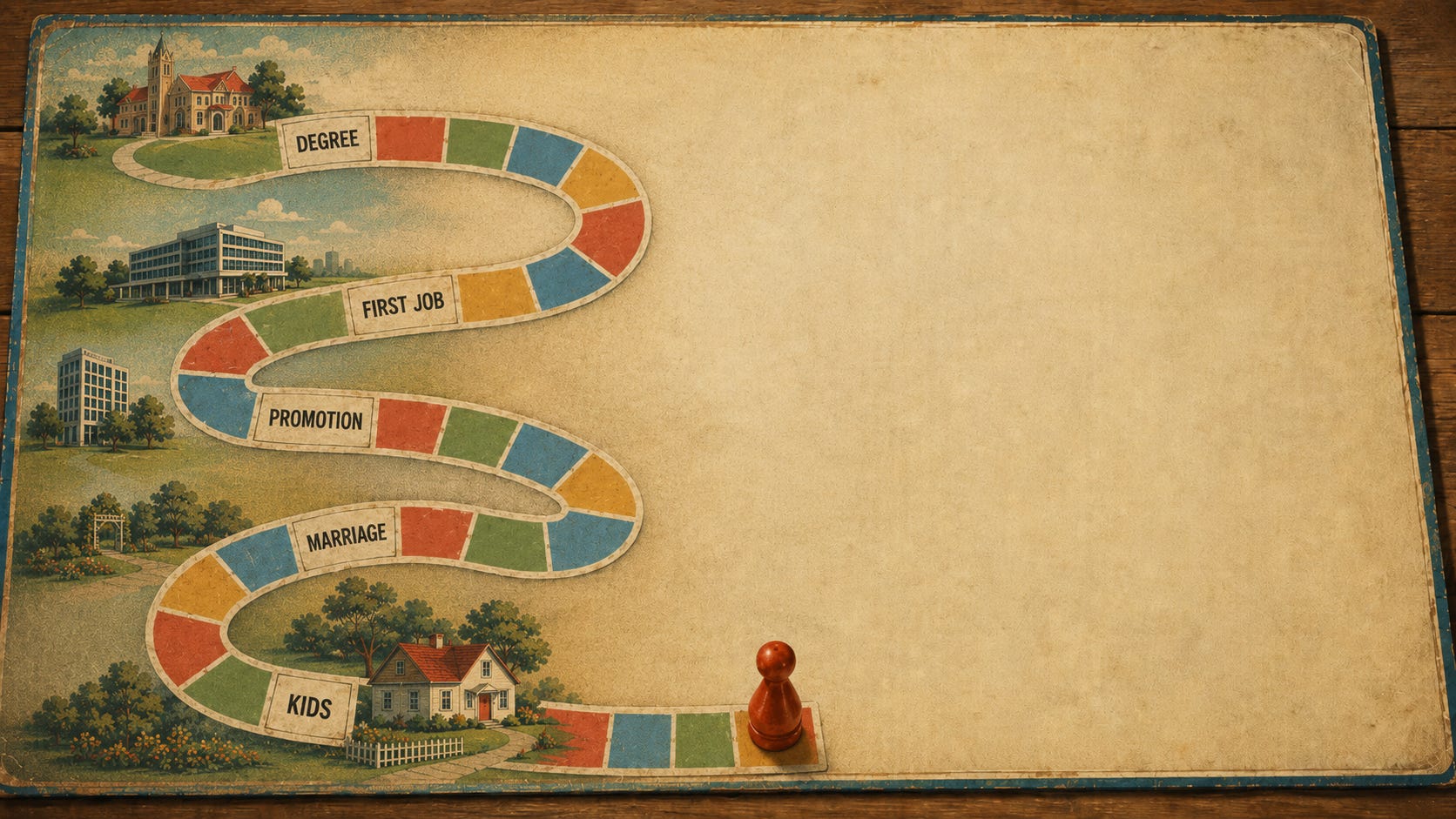
Until recently, my life felt very linear, like a story unfolding that made sense and was clearly headed somewhere. Now, though, it feels like that linearity has ended. It’s not that progress has stalled, per se. I’m still learning and growing, at least as rapidly as before, if not even more rapidly now. But it increasingly feels like I’ve taken the train all the way to the last stop, the end of the line, and it’s not clear what comes next.
The world is changing faster than ever and all of this change has got me thinking a lot about drive, ambition, and satisfaction in the context of my own life. I tend to reflect on life in a series of chapters. In general, in each successive chapter, things get a little better. Those life stages are chapters because they have a start, middle, and end, and there’s a close to each chapter. I tend to think of these chapters as checkpoints too, in the video game sense of the word: a place you can always return to. The goal is steady, consistent progress, but I can also go back to the previous chapter if needed. For example, I worked in finance prior to business school and decided to use business school as a launchpad for entrepreneurship, but I always felt that I could go back to finance if I changed my mind. In practice, I’ve never done this, not even once, but it’s somehow reassuring to know the option exists.
That story made sense up to now, but it’s run its course. All finite games must end, and this relatively linear path I’ve been on is no exception. By all traditional accounts I’ve done the big things I was supposed to do. So: what comes next?
I know I’m not alone. The world of the past few decades is breaking for a lot of people. AI is playing a role here, but it’s not only about AI. The world really is changing in some big ways. A lot of people are reacting to this moment in fear. That’s understandable, but I don’t think it’s the best or healthiest reaction. Every moment of crisis is equally a moment of opportunity, and I see incredible opportunity in this moment. For the first time, the script has run out, and that’s an exciting chance to write my own. I’m sure I’m not the only person in the midst of redefining his identity given everything that’s changing.
Keep Driving 🚗
My entire life, I’ve never stopped pushing. My inclination now is to do the same. I’ve always been ambitious and each year has been better than the last.
Why the drive and ambition? I’m not entirely sure myself. I’ve always been this way. Attempting to explain is an interesting experiment in self analysis. Maybe I’m trying to prove something to myself and to the world. Maybe it’s because I come from nothing: I was on welfare as a child, my mother didn’t finish college and was unemployed for most of her life, my father never made much money and wasn’t very present.
Maybe it’s because I want to know what I’m capable of. I’ve known very few limits in my life. I’m quite an extreme person. I like pushing things to the limits, because in my mind it’s the only way to know where those limits are. I’ve achieved a lot, but I know in my heart that I’m capable of even more, which is one reason I keep driving.
Then there’s the genuine desire to do good in the world. This is the biggest motivation of all. I’ve felt this way as long as I can remember. I’ve always felt that apathy isn’t an option: it’s cliche, but it’s true, that we must be the good we want to see in the world. I see injustices and inequities, social and economic failures all around me. I see people suffering unnecessarily, and I feel called to help people where I can.
With respect to the last point, I don’t expect this to make sense to most people, nor do I expect others to feel this way. I understand why most people choose to focus on the people around them. That’s rational too. But I’ve always felt something resembling a higher calling. I still don’t know what it is, exactly, but it’s always felt just over the next hill, and it’s the closest thing I have to a north star that’s always kept me moving forward.
In recent years, this desire has been somewhat tempered by maturation and by understanding that change is hard, even when you work hard, even when you have the best intentions. So many attempts to effect positive change in fact produce the opposite, and there are iron rules like oligarchy and economies of scale that make addressing inequities impossibly difficult. But I still feel like I can do more, and that I can’t rest until I’ve done all I can. New technologies like blockchain and, now, AI make me feel even more strongly because of the new possibilities they introduce to improve the world. (This is a big reason I’m such a relentless optimist.)
Rest a Bit🪫
On the other hand, life is a marathon, and if I’ve learned one thing from marathoning, it’s that you can’t run full throttle forever or you’ll quickly burn out. Everyone needs to take a break and downshift from time to time. You can’t help others if you can’t take care of yourself.
The best time to hit pause is after achieving an intermediate goal. It’s absolutely essential to have intermediate goals, to celebrate those smaller wins as they happen, and to take a step back and reevaluate the big picture from time to time. I’ve blown past too many significant milestones without stopping to celebrate them properly and reflect on what comes next: most recently, moving across the world, having another child, and (for now) leaving the industry I’ve been in for a decade. It’s now time to hit pause, and I’m very much in the middle of the reflection process.
I don’t know how long it will take. I don’t know how long it’s supposed to take. The last time I really took a break was nearly ten years ago, and it took nearly a year until I felt confident about what I wanted to work on next. (At the time, the answer was Ethereum, and more generally, decentralized crypto networks.) I was hoping the next break would come sooner, but this is the first time the opportunity really presented itself, so I plan to take full advantage of it.

The other time when it really makes sense to take some time off, or just slow down, is when you have young kids—which, for me, is right now. The other things I want to do—travel, building, making money, changing the world, whatever—the reality is, those things can wait. My family can’t. My kids aren’t going to be young for very long. The time we have together now is incredibly precious, and in the grand scheme of things, it’s actually very short. My work means a great deal to me, but family always comes first.
This is one of the reasons I’m taking my time to get fully back into the arena. The past few years, I spent the vast majority of my time working and traveling, and traveling for work. Even when I wasn’t working, I was thinking about work, stressed about work, obsessing over work. All of that was time I couldn’t focus on the critical, here and now things, including health and family.
Why is being a good parent so important to me? Probably because my parents weren’t very good parents, and because I want the generational cycle to end here. But it’s related to work too. While there are lots of hypotheticals in my work—it just might, someday, somehow, have a big impact on a bunch of hypothetical people somewhere—parenting is something that has a real, concrete impact on the people I love today, no hypotheticals. That makes it the most meaningful thing I can do.
Still, things are changing so fast today, the opportunity cost feels so great, I feel the calling to go back to work full throttle. And I also feel the calling towards a simpler, slower, more sustainable life that’s more family-focused. Life is full of difficult choices, but I also feel privileged to have this choice in the first place.
I know there’s no right or wrong answer here, which is reassuring. There’s just the answer that’s right for a particular person or family at a particular point in time. This is why I try so hard not to judge others’ decisions, and why I try not to stress out about my own decision. If I decide to wipe tables for the rest of my life, I think that’s perfectly okay. My mindfulness practice has taught me that that, too, could be a really meaningful life. How much do you actually need? In my experience, the less you need, the lighter life gets.
Who Am I?🪞
Ultimately, it’s a question of identity. Who are you, first and foremost, to yourself, to the people around you, to the people who matter the most to you, and to the world? There are no easy answers to this question. It’s something we all need to sit with and consider. You can be anything, but you can’t be everything to everyone.
Identity isn’t something I reflect on as often as I should. You shouldn’t just let identity happen to you; you should take an active role in shaping and defining it. Identity is something I’ve struggled with for a long time; I’ve long called myself a proud bundle of contradictions. As Walt Whitman famously said:
Do I contradict myself?
Very well then I contradict myself,
(I am large, I contain multitudes.)
For a long time, those contradictions caused me grief and gave me anxiety, because many of those multiple identities conflict and even contradict one another. For instance, two of my core values are loyalty and innovation. On the face of it those may seem compatible, but it’s not hard to think of a situation where they conflict. Imagine having to choose between loyalty to existing people and processes, and pursuing innovation.
I also value both compassion and excellence. These, too, collide all the time. Imagine having to deal with a team member who’s a good person but a bad fit on the team. Compassion says to handle the situation gently, while excellence says to let them go right away to make room for a stronger fit. (Experience has taught me that the compassionate thing to do is usually, in fact, to let the person go right away, but there are more and less compassionate ways to do that.)
There are even more straightforward ways in which complex identity comes into conflict on a day-to-day basis. The most obvious example is work versus family. Yes, it’s possible to be both a good parent and to have good work ethic, but at the end of the day, your time and attention are zero sum: every extra hour, every extra bit of attention you give to one is a bit that starves the other.
This is the thing that bothers me when friends tell me they plan to “have everything”: to be good, active, hands-on parents, but also not to make any sacrifices in their career or personal life. I know from experience that that just isn’t possible. Anyone who says that is either naive or is lying to themself. I’ve literally never met someone who’s maximally good at both career and parenting. You can be good, even very good, at both, but the reality is that these two will constantly collide and, ultimately, one or the other has to come first. It’s just one of those unavoidable choices: if you don’t choose, the choice will be made for you.
While I do think that raising a child is the most meaningful, important, socially valuable thing you can possibly do, I also understand that some people feel their work is also meaningful, important, and socially valuable. I feel that way too, as I just said. To those parents, I just ask the same question: what’s your core identity? What are you absolutely unwilling to compromise on?
Sahil Bloom has a concept that I really like, called the life razor (a razor is a device we can use to simplify a decision, or avoid unnecessary action, like the famous Occam’s razor). The life razor is a device you can use to decide what wins when your identities collide—something that, in my experience, happens more often than you might expect.
The question becomes: what’s your life razor? This is the thing that defines who you are. Are you the high powered business executive, always in demand, constantly traveling for work? Are you the dad who is always there for your kids, always home in time for dinner, who never misses your kid’s soccer game? Because you can’t be both. Sure, you can forge your own identity. You definitely do not need to conform to this or that stereotype. Your identity can and should be multi-layered and complex; you, too, should contain multitudes. But when conflict inevitably arises, you need a way to decide. You still have to pick one prime value, one core identity.
The life razor is the thing that reconciles it all for me. My life razor at this stage of my life is: I’m the kind of dad who always meets my son after school and always takes him to soccer practice. That means saying no to lots of personal and professional opportunities, but it also opens the door to lots of beautiful possibilities.
Of course I’m much more than a dad. Each of us is a bundle of identities. No one is one thing, all the time, everywhere, to everyone, not even the most extreme, obsessive, monomaniacal person. The person we are at home around our family is usually very different from the person we are at work, in public, or in other contexts.
For the longest time, my identity was some combination of things: consultant, entrepreneur, writer, educator, builder, investor. Parent, yes, although that came later and, to be honest, it’s something I’m still growing into, even after four years. To be clear, those are all still aspects of my personality, but I’m much clearer now than I was on my core identity. I haven’t worked out the precise wording, but my broader self-identity today is something like: I’m a technologist entrepreneur who is building a better future for his kids. Of course, this core identity is still multi-layered, and it’s the fact that I have a firm life razor in mind that allows me to reconcile these competing aspects of my personality.
Being this kind of father—the father I never had—is presently at the center of my identity, and it’s grounding. It’s more than enough for now.