Why I Run
Three Things #194: November 9, 2025

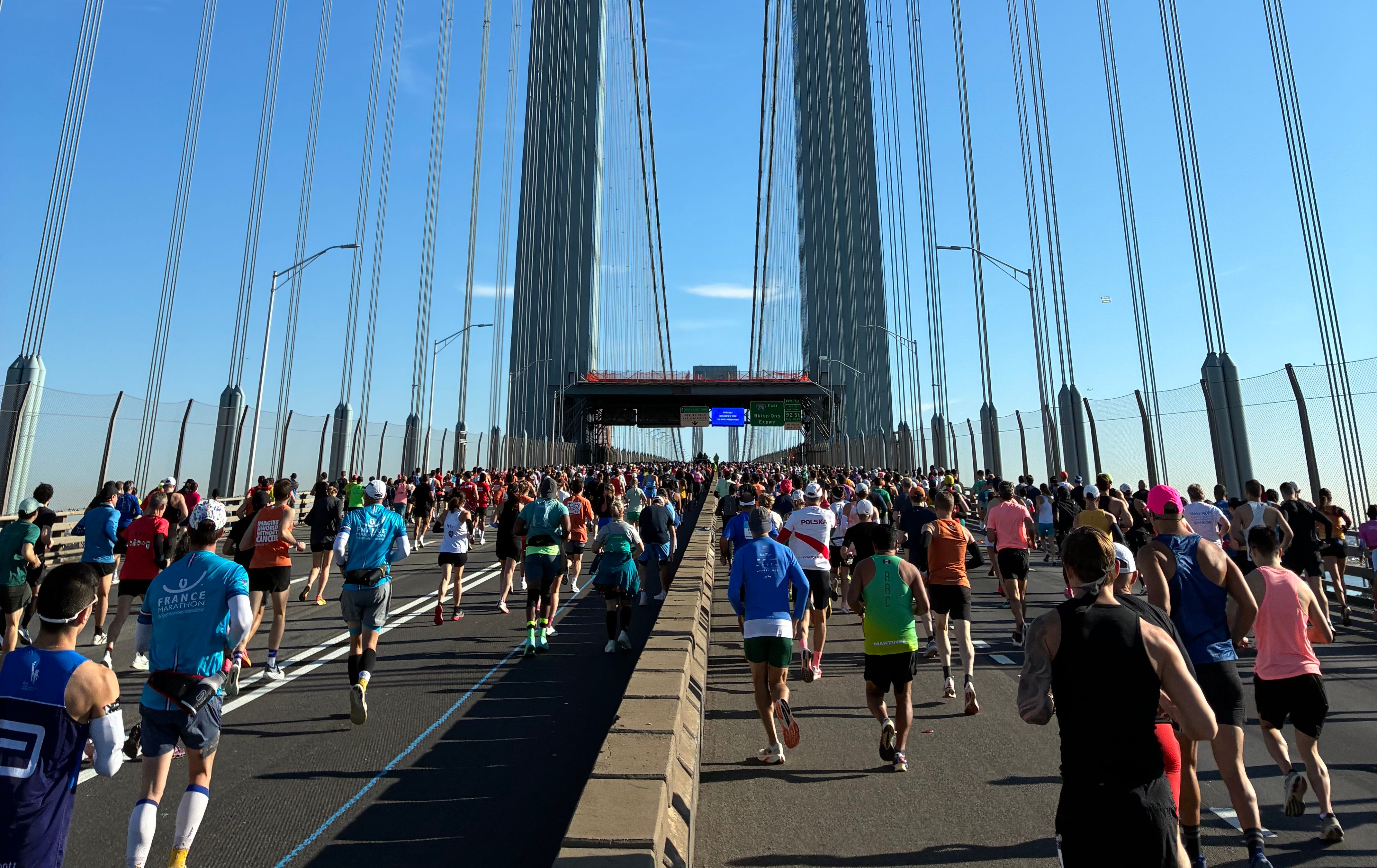
I’ve written about running here a number of times, and I’ve touched upon why it matters so much to me, but I haven’t fully explored the topic. I just finished the NYC Marathon again so this topic is on my mind and it’s something I’ve been reflecting on—in fact, it’s something that I had plenty of time to reflect on while running.
Here, in a nutshell, is why I run, and why running has been such a constant for me despite all sorts of other changes: changing jobs, moving across the world, becoming a parent, etc.
Thing #1: Health 💪
The most obvious reason to run is for health. This is one of the reasons I started running, and it’s one of the reasons I continue to run nearly every day. There are different kinds of fitness, and different kinds of exercises to achieve different kinds of fitness, but I’ve always believed that, if you’re going to pick a single form of exercise, you should pick running. This is one of the reasons I started with running rather than, say, lifting weights or doing yoga.
A healthy heart and lungs, while not enough on its own, goes a long way towards improving quality of life and giving you longevity. There’s ample evidence that runners, and people who are generally on their feet more and are more active, live longer, healthier lives than those who are less active. Running also has second and third order positive benefits on health, such as on mental wellbeing and on social health: more on both of these in a moment.
Lifting weights and doing yoga are great, but they don’t provide the same cardiovascular benefits that running does. Of course, in an ideal world, you’d do all three, or combine running with other forms of cross training. But if you have to pick one, even for a limited period of time, I’d pick running.
Every official recommendation for health suggests that you need to be active, and get your heart rate up, for at least ~30 minutes per day. Running is one of the easiest ways to achieve this. Swimming and biking offer similar cardio benefits, but unlike running, these sports require specific equipment, access to a pool, etc. One of the beautiful things about running is that the only thing you need is a good pair of shoes and an open road, which you can find pretty much anywhere. Take it from me, as I’ve continued to run while traveling intensely the past few years. I can also attest to the fact that it’s possible to run in pretty much all weather, something I spent several years doing in New York across all of the seasons and conditions.
Many stop-and-start sports involve sprinting, jumping, and rapid direction changes, which place greater mechanical stress on the body and often become harder to sustain with age compared to steady, self-paced running. And, while running can be extremely social, it’s also something you can obviously do by yourself, which makes it ideal for someone like me with a busy, unpredictable schedule that changes from day to day and week to week and that travels a lot.
Another positive second order benefit of running is that it improves your sleep. This is another reason I began running. I’ve always struggled with insomnia and trouble falling asleep, and I found that I always sleep better after a solid run. There’s something magic about getting out and burning off the extra energy.
And the great irony, and great magic, of running, and of exercise is general, is that, while it consumes energy in the moment, it increases your body’s overall capacity to produce energy. Regular training builds more mitochondria in your muscles, improves cardiovascular efficiency, and stabilizes your metabolism and sleep—so people who exercise consistently tend to feel more energetic, not less. I’ve seen this in others and in myself: during periods when I exercise regularly, my day-to-day energy is far higher than when I don’t.
Finally, there’s the psychological impact, and the impact on my mood. I can be in the worst mood in the world, but running for an hour reliably puts me in a good mood. I always feel amazing after a run, always. In this respect, running is my favorite method for coping with stress, anxiety, and a variety of other challenging emotions. By contrast, when I can’t run or exercise for a few days, I begin to go crazy. I hate that feeling.
Thing #2: Community 🤜🤛
Running is unique in that it can be a solo sport or a group activity. You can shoot hoops alone, or kick a soccer ball around by yourself, but you’re not “playing basketball” or “playing soccer” if you do. Running alone is, obviously, still running.
The fact that you can run by yourself pretty much anytime, anywhere, is one of the big things that attracted me to the sport, as I mentioned above. I played group sports like soccer when I was younger. I really enjoyed soccer, and in fact I still do, but I struggle with needing to find a bunch of people to play with you. This requires coordinating everyone’s schedules, being in the same place at the same time, day after day, week after week, predictably, which just isn’t possible given the nature of my work, and the amount of travel I do.
Running solo isn’t just convenient, it’s also fundamentally different than running in a group. It’s some of the only time I get to myself: to think, to reflect, or just to be alone. I’ve written before about the importance of reflection time; I don’t have a lot of time for long, lonely walks or hikes to reflect, but I do find that I can achieve this while running. It somehow allows me to gain new perspective on my problems, by stepping outside my day to day context. I also find that it’s a good way to be in touch with my body and to understand how I’m feeling: the sheer physicality of running is enjoyable, and challenging, and it’s a great way to keep tabs on my overall health and fitness level. It also improves my mood, as I mentioned above.
I also enjoy running in a group, but this is a totally different experience than running alone. I moved to a new city earlier this year, and I’ve actually found that running clubs and other fitness clubs are one of the best ways to meet people. They’re especially good for introverts like me. I don’t do well at parties or in bars, which feel overwhelming, but there’s something about a shared physical experience and challenge that helps me, and other introverts, open up.
There’s also something to be said for the accountability of running together: when you run alone, you’re accountable only to yourself, so if you decide to do a shorter run, or a slower run, or to skip a run entirely, no one is going to yell at you. No one’s going to be standing there in the early morning, shivering, wondering where the heck you are if you’re late. At times, especially when I found running more difficult than I do today, I found that knowing that someone else is waiting for me to show up is a powerful motivator.
And then there’s the marathon. It’s difficult to describe the communal experience of running a marathon with thousands of other people to someone who hasn’t experienced it before. You’re surrounded by people from all walks of life, from all over the world, who all share something powerful in common: not just a single run, but the months of struggle and challenge and pain and joy that are inevitably associated with any marathon training regime. At the end of the day, it doesn’t matter how young or old, strong or weak, fast or slow you are: the marathon challenges everyone, and the challenges are similar and will sound familiar to any marathoner: sore feet, broken toenails, chafed nipples, countless hours pounding pavement in all sorts of weather. Struggling in the same way for months and months, even over vast distances, even among total strangers, has a strange way of bringing people together. Marathoners are all keen to share their stories, their struggles, their hopes and fears, their training tips, etc.: it’s like a universal language.
On marathon day, the entire city comes alive and feels connected. This is especially rare in a hyper-capitalist, hyper-individualistic city like New York. Everyone is in a better mood. People are more patient, gentle, and understanding than usual. People go out of their way to help one another. Over a million New Yorkers come out to watch the marathon, and to cheer on the runners—mostly total strangers, people they share almost nothing with and will literally never see again.
I find that solidarity and communal spirit intoxicating. There are no words to describe the feeling of struggling over a bridge or a quiet stretch of the course, turning a corner, and suddenly finding yourself immersed in screams of encouragement from thousands of people, live music, horns, and confetti. You see other people struggling and overcoming challenges, and you feel connected to them and happy for them. It makes you feel alive, and connected to the people around you, in a way that nothing else I’ve ever experienced does.
Thing #3: Ability 🦸🏼♀️
I didn’t grow up athletic at all. I was bookish and I didn’t play any sports as a child. I started running on a whim, and out of curiosity. I saw other people doing it, it looked fun, and it didn’t seem too difficult. I like being outdoors. I decided, why not give it a shot?
At the same time, it also felt impossible. A marathon was beyond comprehension and definitely out of the question. I could contemplate someday running as far as one full lap around Central Park, or about 10k, but even this felt completely impossible when I started. I had heard rumors of people who ran as far as 10k every morning, and the thought blew my mind.
There’s a short, 1.5-ish mile loop around the reservoir in Central Park near where I grew up, and I remember the first time I tried to run this distance. It was challenging, but I managed. I was off to a good start. From there, progress was incremental. Running is extremely incremental. Add a little distance day to day, week to week, and before you know it, you’ll be running serious distances. It took a few months, but before I knew it, I was running 10k without too much trouble.
I also clearly remember my first half marathon, and my first marathon. My first half marathon was in Macau in 2010, while I was living in Hong Kong. The full marathon course involved running the half marathon route twice. So, when I finished the half, I saw runners continuing on to do it all over again. I felt like I was going to die, I was so tired, and I had never run that distance before. I remember thinking that the marathoners were out of their freaking minds, and promising myself that I’d never attempt a full marathon.
I ran my first full marathon about a year later, in Philadelphia, during my first semester of business school. I previously described the challenge. With each successive training run, I was amazed at what I was capable of: 12 miles, 14 miles, 16 miles, 18 miles. These were all previously unfathomable distances to me. Yes, there were challenges, but running still felt incremental. I could still keep increasing distance gradually and sustainably.
And I clearly remember finishing that marathon. One of my business school professors, also an accomplished marathoner, acted as something of a coach to students who signed up for the race. He ran the last mile with me, which was an extremely powerful gesture of support. I remember even on race day being legitimately afraid that I wouldn’t be able to finish. I had only managed to train on distances up to about 18-19 miles, and I was afraid of hitting the wall. Again, I had never run that distance before.
But I finished that race, faster than I expected. I cried at the end. It was an emotion I had never felt before. It was a powerful combination of achievement, surrender, and gratitude. Achievement for accomplishing something truly remarkable, something I didn’t think I could do. Surrender for the overwhelming physicality of the experience: feeling more exhausted and sore than I had ever felt before in my life. And gratitude that it had all been possible, and for the experience. I still feel that way when I finish a marathon, every single time.
That first marathon was a massive turning point for me. It’s cliche, I know, but it’s absolutely true: it showed me that I’m capable of anything I put my mind to. It showed me the value of hard work and of persistent, incremental effort. That lesson has been valuable throughout my life and my career: I think it’s one of the single most important lessons I ever learned. You can’t do everything, but you can do anything if you put your mind to it and work hard, day by day.
My self-identity was a bookish nerd who was terrible at sports, but I proved to myself that I could alter that identity with hard work. It’s the same spirit that motivated me to go back to school, to study business, to become an entrepreneur, to move across the world multiple times, to adopt multiple foreign languages and cultures, to change industries multiple times, and to take on new physical challenges like running a faster marathon, or getting stronger. Why? Because I’ve done harder things before, so I know that I can do this, too.
What still feels impossible to me? Lots of things. An ultramarathon, for one. A three hour marathon, which I failed to do two years ago. A triathlon. Becoming strong enough to deadlift or bench press hundreds of pounds. I’m not rushing into these challenges all at once, because there are only so many hours in a week and because there are other important things in my life like family and work. But I don’t intend to slow down my embrace of big, hairy, audacious goals anytime soon. The marathon showed me how.