Advice to My Younger Self
Three Things #195: November 16, 2025

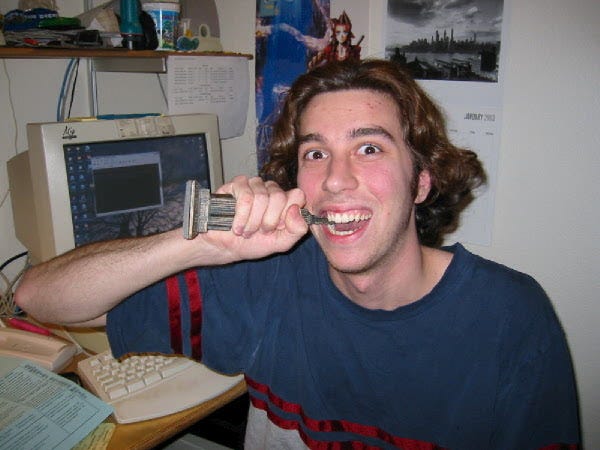
Advice has been a constant theme here, and many or even most of what I write here is probably advice of one form or another. I would never offer advice to someone else that I wouldn’t follow myself, so it could even be construed as advice to myself. But for all that I’ve never explicitly written a piece on advice.
I don’t feel qualified to give advice per se, but I’ve seen a number of threads on social media lately along the lines of, “what advice do you have to offer to younger folks?” As usual, I prefer to respond here, in long form.
Here are three pieces of advice I would give to a younger version of myself, ten or twenty years ago.
Thing #1: Get Married and Have Kids 👶🏻
This is the single most important, concrete piece of advice I’d give myself.
Things turned out okay, and I’ve been incredibly lucky. I have an amazing partner and an amazing family. In this respect I have no complaints and no regrets.
But, other things equal, I should’ve and could’ve done it earlier. Why earlier? The simple, straightforward reason is that it’s easier to have kids, and it’s easier to have multiple kids, if you start earlier. The more complex reason is that having children makes you a better person because it forces you to be less selfish. I wonder what I would’ve done with, say, ten extra selfless years, relative to what I actually used that time doing.
There’s an unfortunate brain virus in modern society. The virus makes people think that the purpose of life is to enjoy themselves, to express themselves, to explore themselves, things like that. These things couldn’t be further from the truth. The purpose of life cannot be something self-centered, because that’s the oldest, most obvious recipe for long-term unhappiness. People who are really, truly happy over the long term all have one thing in common: they’re living for something much bigger than themselves.
The easiest route there for most of us is becoming a parent. For others, it might be religion or community or charity. I do believe that modern, urban, liberal society will eventually wake up from this malaise, but in the meantime, it’s producing an entire generation of young to middle aged people who missed the marriage and kids train entirely and who are, sadly, destined for long term loneliness. They don’t realize this, don’t understand it, and cannot be convinced of it. If you ask them, they’ll all tell you that life is just fine—they’re chronically unable to think of the future, and unable to see the lonely older folks all around them. This makes me terribly sad. I had to get married and have kids to realize this.
By all means, explore. Have some fun. That’s what your twenties is for. Then, prepare to settle down and have kids.
Having children brings you an insane amount of joy. Nothing else I’ve ever experienced even comes close. I’ve had a pretty happy life, at least since becoming an adult. But, to the extent that joy and happiness matter, I’m certain I would’ve been happier if I had started a family earlier. I also wonder what difference an additional ten years of that sort of joy might’ve made.
What about the other side of the equation? Would having kids younger have prevented me from doing things that have made me happy? I’ve thought about this quite a bit and I can confidently say no. My experience has been that having kids doesn’t prevent you from doing anything. It makes certain things more logistically complex, obviously. And it helps enormously to have the right partner, and a supportive family and community. For me, the net impact of having kids has instead been to force me to ruthlessly prioritize the things in my life, which is completely healthy. It’s less about preventing me from doing anything specific, and more about forcing me to invest only in the most important things. I can do anything, I just can’t do everything: that was always true, of course, but it becomes more obvious as a parent. I wonder, too, what an additional ten years of this sort of focus would’ve meant for my life and career up to this point.
And what about marriage? This is a bit more complex. Obviously you don’t have to get married to have kids, and my feelings towards marriage are a bit more nuanced. I don’t think I would’ve chosen to get married in the absence of the desire to start a family. Marriage changes very little about your relationship with your partner. But being married does make a difference when kids enter the picture. Marriage is the correct, stable foundation for building a family, and giving your kids the best chance of success. Put differently, I’m not exactly a huge advocate for marriage in and of itself, but to the extent that it enables raising children the right way, I think it’s a wonderful institution.
I also recognize that, parenting aside, in certain ways marriage has made me a better person. The best way I can sum it up is: marriage has taught me that the more you invest in a thing, the more you get out of that thing. This lesson is useful far beyond marriage and family life. It’s a universal constant in the world, and I had to get married to understand it.
Thing #2: Spend More Time in the Gym 🏋🏻♂️
I didn’t grow up athletic. My parents always encouraged me to study rather than “wasting time” on sports. Eventually, on my own I discovered running, and over time became quite passionate about it. I developed a taste for yoga as well. I liked fitness, I liked being active, but spending time in the gym never appealed to me.
My logic was pretty straightforward, if simplistic and misguided: cardio activities like running, swimming, and biking contribute to longevity. Adding muscle mass does not. I thought I was already strong enough, especially in the sense that I could run for hours without tiring. And I had no particular desire to have bigger muscles for aesthetic reasons. It felt silly. It felt superficial and like a waste of time. What’s worse, I had a negative impression that guys who hang out in the gym are “meatheads.”
It didn’t help that, on the rare occasion when I visited the gym, I felt totally out of my element. I had no clue what I was doing. No one had ever showed me the ropes. And, unlike running, which you can mostly figure out on your own, when it comes to the gym, to using the equipment safely and effectively, you do need someone to show you the ropes. As I’ve come to understand over the past couple of years, there’s a great deal of technique to training well, efficiently, and safely.
I finally began strength training around two years ago, when I turned 40 and realized that it was the last decade when I could still gain strength relatively easily. In the beginning, it was awkward. I initially couldn’t afford to hire a personal trainer, and didn’t really have any friends who could help, so I started with Youtube videos and Apple Fitness+. This actually wasn’t a terrible way to begin.
I spent a few months doing this, strength training taking a back seat to my running, until I eventually bit the bullet and hired a personal trainer. I’ve been working with one since, and I haven’t looked back: it’s expensive, but it’s worth every penny. I gradually increased the volume and intensity of my strength training, up to a few hours a week, until it surpassed even the time I was spending running. After trying a few different routines, I landed on one that works well for me: each week, one day each of lower body, chest, back and shoulders, and accessory work. I’ve made slow and steady progress since then. I’ve plateaued a few times, and faced challenges like strength training while also running a lot, and while traveling, but each time I get stuck, I eventually get unstuck and start to make progress again.
If you had told me a couple of years ago that I’d spend more time lifting weights than running, and that I’d enjoy doing it, I would’ve laughed at you. But in the span of just a few months I really have grown to enjoy my time in the gym. Today, I miss the gym when I can’t go, and after a couple of years of working with a trainer I finally have the confidence to spend time in the gym alone.
The outcome isn’t what I expected. I really had no clue how weak I was before I began strength training. Everything in life has become easier since. I can carry groceries and furniture much more easily than before—that may sound small and silly, but it actually has an extremely positive affect on mood and confidence. Even more importantly, I can play with my son, who’s growing fast and not getting any lighter: confidently lifting him up, spinning him around, etc. I’m the only person in the household who can still do this with him, and I doubt I could’ve done it without strength training. I’ve noticed, during my yearly checkpoint at Burning Man, that I’m able to carry heavy things and work on our art project much more easily than before, and without being sore after.
My posture is better. I sleep better. I have more energy. I’m more confident and better able to focus on work. My testosterone count is higher. I’m less worried about sarcopenia and osteoporosis. It’s hard to put all the benefits into words, and some of the benefits are intangible, but I just feel much better on days when I work out. I leave the gym feeling exhausted and refreshed and happy, and even the muscle soreness over the following day or two makes me happy.
Time spent in the gym is not time wasted. I was wrong about this. It matters more as you age, but it’s never too early to start. As with so many things, you may not like it the first time, but the more you do it, the more you’ll grow to like it. Making it a social thing, whether with friends or by hiring a trainer, can help a lot. And, as it turns out, strength and resistance training are actually an important part of lifelong health and longevity. I wish I had known all of these things ten years earlier, but I’m also grateful that I figured them out when I did.
Thing #3: You’re in Control 🕹️
There seems to be a theme among advice books for young people, especially Millennials and Gen Z’ers, along the following lines: you don’t need to conform to society’s expectations of you. You don’t need to subscribe to anyone else’s definition of success. You can create the life you want to create, if you’re willing to take a few bold steps and take some risks and take more agency. (This one is especially good. I highly recommend it.)
There’s a reason people need to read self help books to learn this lesson. Unless you grow up with really weird parents, it’s not an idea that most of us are exposed to early in life. The society that most of us grow up in is quite structured, and the way most of us experience this during our formative years is in school. For most of us, school is the most rigid structure of all: fixed classes, fixed grades, fixed lunch periods, etc., with scant room for creativity or experimentation.
That’s not a coincidence. We used to educate people through an apprenticeship system, where apprentices would receive practical training in a craft from a master, with plenty of room for individual attention and creativity. That all changed during the mechanical revolution and the dawn of the industrial age, when modern schools were launched. These schools operated like factories, and the students are the product. School still works this way in most places. The best way to guarantee success and efficiency in a factory is sameness: all of the products should turn out exactly the same.
It’s actually possible, just barely, to remain in the factory your entire life: from grade school through university through a career like law, which is also highly structured. This structure is attractive to many people, because when you’re used to structure, when it’s all you’ve known your whole life, a sudden lack of structure is scary. I was in a very structured system up to and including graduate school, but then took a bold step away from the traditional career path when I decided to pursue entrepreneurship rather than recruiting for a job in an industry such as finance or consulting.
This wasn’t an easy or an obvious decision for me. My father, an immigrant, had quite conservative values and was surprised when I decided to leave my secure, high paying finance job. It was scary for me, too, a big step into the unknown. I had an inkling that another life was possible, and I had a sense that, while I thought I was happy, I wasn’t actually as happy as I could’ve been. I had a sense that entrepreneurship might be for me. I also knew that the only way to find out was to actually try it.
It turned out that I was right. Taking control of my life, having more agency, was just what I needed. Even though I took a big pay cut and stopped taking business class flights, even though my work was much less glamorous than it had been, as a struggling entrepreneur I was much happier than I had ever been before, and I was much happier than I had previously thought possible. And the reason was agency: success or failure, I was in the driver’s seat and I had no one to blame but myself. I found that feeling exhilarating in a way that being an employee on a traditional career track had never been before.
I got off the traditional career track about ten years ago and I’ve never looked back. My career today is anything but traditional—I still have trouble explaining what I do, even to my own family—but it’s deeply fulfilling. I wake up every morning feeling genuinely excited and lucky to be able to do what I do.
I learned a few other things along the way. Agency unlocks more than just career fulfillment and discovering a calling. It also unlocks a lot of fun, it turns out.
You see, early on we’re taught that work isn’t meant to be fun. Work is the annoying thing we have to do in order to enable more fun things, i.e., leisure. We’re not meant to enjoy work; at best, we’re meant to tolerate it.
This hasn’t been my experience, at least not since embarking upon this journey. I’ve found that work can be just as much fun as we make it, and it can be as much fun as we want it to be. The secret is to not take ourselves, or our work, too seriously. I don’t mean that we shouldn’t work hard, or seriously, but it’s possible to embrace fun in all that we do: to make it a core value.
Choose work that brings you delight. Choose to work with people that make you smile. Take yourself seriously, but not too seriously.
Take more agency, early and often. The path won’t be easy, and as I share my story I recognize my own privilege, but the path is there, if you’re willing to step onto it. This is something else that I wish I had known much earlier, though I suspect that, even if someone had tried to explain it to me, I wouldn’t have understood or believed them!
Really enjoy ur posts Lane! By your highschool pic I laughed thinking you look exactly like my college roommate and best man (which is why connect with ur posts). I've made many of the same connections about family, purpose in work and more recently the benefits and joy of exercise/running. I had 2 kids earlier bc my wife is a few years older and pleasantly surprised at the benefits of now being an empty nester at 48! Cheers to us for finding a lovely path in life! Maybe we'll cross paths running in central park! Keep writing! -Mehul